Certain plants have been documented across traditional practice systems for their apparent capacity to help the body maintain composure under varying demands. The contemporary research literature calls these plants adaptogens — a working category rather than a formal botanical classification. What follows is a structured overview of the most referenced specimens and their observed roles in nutritional formulations for active men.
What the Category Actually Describes
The term adaptogen was coined in mid-twentieth century research to describe substances that increase non-specific resistance — the body's general capacity to maintain normal function across a range of external pressures. This is a deliberately broad definition. It does not describe a single mechanism, a single plant family, or a single mode of action.
What plants in this category share is a documented interaction with the body's stress-response axis — the network of physiological signals that regulates energy expenditure, immune readiness, and recovery pacing. The quality of that interaction differs between plants. Some appear to modulate the cortisol-release pattern; others seem to influence cellular energy production more directly. The field is active, the evidence base is growing, and most practitioners now treat individual specimens on their own merits rather than as a unified group.
For men following active daily routines — extended work schedules, fitness commitments, variable sleep patterns — the interest in these plants is practical: not transformation, but maintenance. The language of the field reflects this. Adaptogens are described as supporting resilience, sustaining baseline function, and reducing the performance cost of accumulated stress.
"The research language is careful: adaptogens are observed to support normal function, not to produce extraordinary outcomes."
Kaldo Letters — Field Notes, February 2026
Ashwagandha: The Most Documented Specimen
Of all plants categorised as adaptogens, ashwagandha (Withania somnifera) carries the most substantial body of published research. Studies published in peer-reviewed nutrition journals have examined its relationship with energy metabolism, cognitive function under pressure, and sleep architecture. The consistent finding across these studies is a measurable modulation of the stress-response pattern — specifically, a reduction in the amplitude of cortisol fluctuation across the day.
For formulation purposes, the root extract is most commonly cited. Concentration is typically expressed as a percentage of withanolide content — the primary active compound family. Well-documented formulations use a standardised extract providing 2.5–5% withanolides, with daily servings typically between 300mg and 600mg. The form matters: root extract and leaf extract have different compound profiles, and high-quality formulations specify which part of the plant was used.
In daily routine contexts, ashwagandha is commonly positioned as an evening or post-exercise inclusion — partly because its interaction with sleep quality has been observed positively across a number of studies, and partly because its effect on the recovery phase of the day appears more consistent than its acute effect during activity.
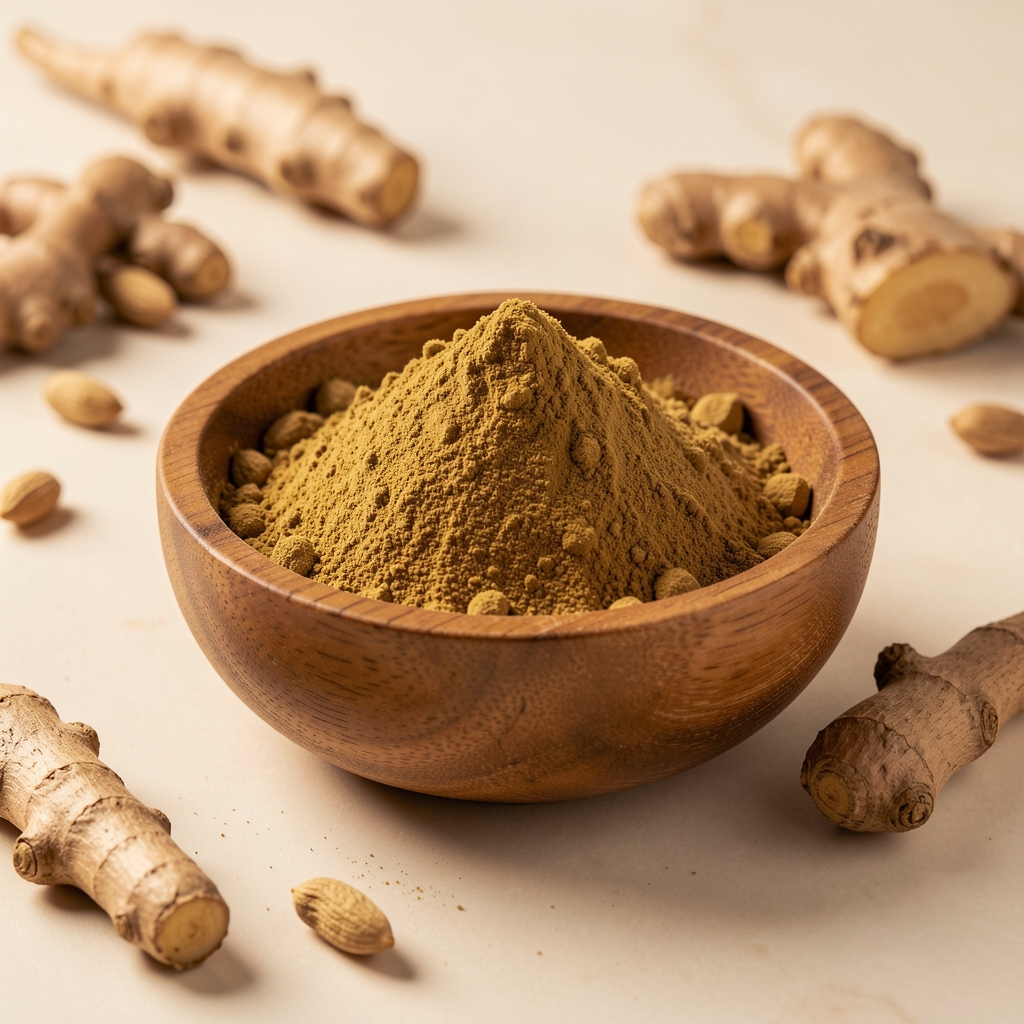
Ashwagandha root — documented for energy metabolism support and resilience formulations.
Rhodiola Rosea: The Altitude Plant
Rhodiola rosea grows at elevation in cold climates — the Siberian highlands, the Scandinavian fjord regions, and parts of central Asia. Its traditional use predates the adaptogen category by centuries; it appears in northern European herbal documentation as early as the sixteenth century as a plant associated with endurance and sustained mental composure.
The contemporary research interest in rhodiola centres on two compound families: rosavins and salidrosides. Published studies have examined rhodiola in the context of sustained cognitive performance during periods of demand, physical endurance, and the quality of focus during extended work sessions. The findings are generally positive but modest — rhodiola appears to support normal function rather than to amplify it beyond baseline.
In formulation practice, rhodiola is typically included at lower concentrations than ashwagandha. A standardised extract providing 3% rosavins and 1% salidrosides is the most commonly cited benchmark. Morning or midday inclusion tends to be preferred, given that rhodiola has been associated with a mild stimulating effect in some study participants — an evening placement may not suit all users.
- 01 Adaptogen is a functional category based on observed behaviour, not a botanical classification. Each plant is evaluated independently on the quality of its research base.
- 02 Standardisation matters. Extract concentration and plant part (root versus leaf versus whole plant) significantly affect the compound profile of a formulation.
- 03 Timing within the daily routine is worth considering. Some plants in this category appear better suited to morning use; others align more naturally with an evening or post-exercise placement.
- 04 Published nutritional research typically describes support for normal function. This language is precise: the expectation is maintenance of baseline, not performance beyond it.
Eleuthero and Schisandra: The Supporting Pair
Beyond the two most researched specimens, a second tier of plants occupies a supporting role in daily formulations. Eleuthero (Eleutherococcus senticosus), sometimes called Siberian ginseng despite being taxonomically unrelated to true ginseng, has a research history centred on physical stamina and immune function support. Its active compounds — eleutherosides — are less well-characterised than the withanolides of ashwagandha, but several studies have documented positive associations with sustained physical output.
Schisandra chinensis is perhaps the most versatile of the secondary adaptogens. It is one of the few plants in this category with documented interactions across multiple physiological systems — liver function, cognitive performance, and physical endurance all appear in the published research. Chinese traditional practice classified schisandra as a tonic for all five organ systems, though the contemporary research tends to focus more narrowly on cognitive and physical resilience.
Both plants are more commonly found in combination formulations than as standalone supplements. Their concentration in mixed adaptogen complexes tends to be modest — they function as part of a broader composition rather than as primary active ingredients. When evaluating formulations, the useful question is not simply whether a plant is present, but at what concentration and in what form.
Reading a Formulation Label
The practical value of understanding individual plants is that it enables more critical reading of supplement labels. Several patterns in labelling practice are worth knowing. Proprietary blends that list ingredients without individual quantities make it impossible to assess whether any given plant is present at a research-relevant concentration. A formulation that lists twelve ingredients in a 400mg blend cannot contain meaningful quantities of all twelve.
Standardisation declarations are the clearest quality signal. A label that states "Ashwagandha root extract (KSM-66, standardised to 5% withanolides)" is considerably more informative than one that simply lists "Ashwagandha 200mg". The former tells the reader what they are getting; the latter tells them very little. Third-party batch verification adds another layer of confidence — it confirms that the label accurately reflects the actual compound content.
Ingredient transparency has become a meaningful differentiator in the nutrition market. Brands that publish full formulation breakdowns — plant part, extract ratio, standardisation method, batch verification documentation — are making a different kind of commitment than those that rely on proprietary blend language to obscure their formulation rationale. For readers who take their daily nutritional routine seriously, this transparency is worth seeking out.